
Key Takeaways
- Production costs are primarily dictated by complexity and scale, specifically factors like the crew’s experience level, the number of shooting days, and the intensity of post-production.
- Not all videos are created equal; the cost varies significantly among different video types.
- You can protect your budget by accounting for often-overlooked expenses such as travel permits, music licensing, and excessive revision rounds, early in the pre-production phase.
- Maximizing your ROI isn’t about choosing the cheapest option, but about choosing a production partner like AsiaWorks that aligns technical expertise with your specific regional and creative needs.
Table of Contents
When an organisation decides to create a video, it’s usually because something important needs to be communicated. Something that deserves to be seen and felt, not just read in a mass email or buried in a PowerPoint deck. It could be a brand story, a shift in direction, a message from leadership, a customer testimonial or the launch of a new product or idea. Whatever the message, video has a unique ability to bring clarity and emotion together in a way that helps people not just understand but connect to the organisation.
But before the camera turns on, one burning question always comes first (especially from the marketing department and their limited budgets): How much will this video production cost?
If you’ve already searched online, you’ve likely seen a wide range of numbers. That’s because the cost for video production depends on numerous choices—creative choices, logistical choices, technical choices, editing choices—all of them tied to how the story needs to be told, whether it’s a long or short video production.
This guide breaks down those choices clearly. You’ll walk away knowing:
- What drives the cost of video production
- Why different styles of videos fall into different price ranges
- How to avoid hidden or unexpected costs
- How to stretch your budget without sacrificing quality
And you’ll see how AsiaWorks supports clients with scalable production models, so your video is sized correctly for your needs–neither inflated, nor underpowered.
What Factors Influence the Cost of Video Production?
At AsiaWorks, we break the video production process down into four phases: discovery & design, pre-production, production, and post-production. Each phase contributes to the final cost of video production, but there are many factors that can influence the total cost.
Let’s take a look at the factors that matter most.
1. Experience
“I watch videos all the time, I mean, how hard could it really be to make one?”
Experience is so often overlooked in video production. And it matters. A lot. When you hire an experienced producer or agency, you’re not just paying for their time; you’re paying for their judgement. From quoting, to scoping, to creative advice, that experience means they know what to avoid, what to prioritise, with no surprises. That, more than anything else, will save you money and bring you results.
There’s best practice too. They know what works, what doesn’t, and how to shape a story so it lands with the right audience. They’ll make your people comfortable, make them look great on camera, and keep things calm and professional, something that can only come from years of doing it. They bring strategy, not guesswork. They know how to design content that actually performs rather than just “looks nice”.
In a world where anyone can shoot, edit and produce content on their phone, and where every budget option is catered for, it’s important to never underestimate the professionalism, safe hands and experience of a seasoned producer or agency.
2. Filming Location
The environment you choose shapes the logistics and the budget.
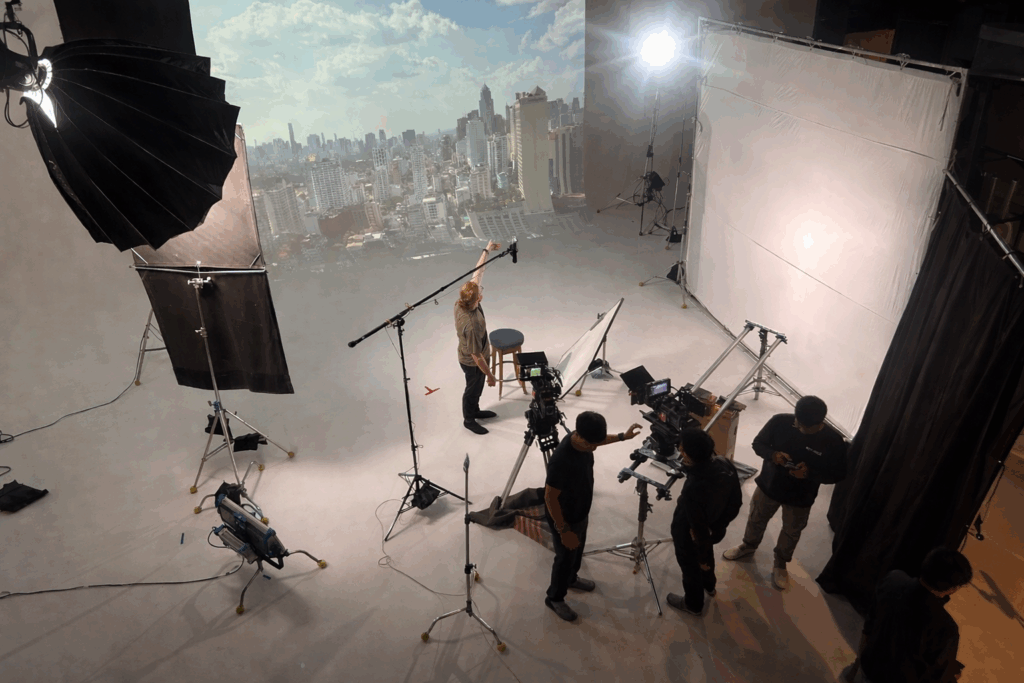
A studio is steady and predictable. For example, you can rent one of AsiaWorks studios (in Bangkok, Jakarta or Singapore) for under US$100 per hour, but an office, factory floor or construction site may require adjustments to lighting, sound (think noises like air-conditioning hum) or movement around the space (elevator dings, phones ringing). Outdoor shoots bring weather, timing and natural light into the equation. Multi-country shoots add travel, coordination, and often local permitting.
Because AsiaWorks has worked in over 20 countries across Asia, Africa, Europe and the Middle East, we’ve built a deep network of trusted local crews and production partners. We are a regional agency with full service offices in Singapore, Bangkok and Jakarta. This means we can often keep travel costs reasonable and maintain consistent production quality across locations. However, the further you get away from your headquarters or offices, the higher the price.
Location costs vary widely:
Small / Medium Location Guide
Most small to mid-sized studios, offices, and flexible spaces typically fall between:
• US$150–US$500 per hour
• US$1,200–US$3,500 for full-day use
Premium Location Guide
For higher-end hotel spaces, museum environments, heritage venues, and large corporate locations, costs rise accordingly. As a broad benchmark, premium locations often fall between:
- US$400–US$1,200 per hour
- US$3,500–US$10,000+ for full-day access
AsiaWorks will usually share these ranges, and once we identify the right locations for your shoot, we’ll lock in confirmed rates.

3. Length of Video Content
A common misconception is that a shorter video equals a lower cost. The rule is that the cost of video production depends on the story, not the runtime.
Short video production costs for a 60–90 second clip might require:
- Multiple interviews
- B-roll filmed across several departments or locations
- Stock footage
- Music selection and rights (original music can be very expensive)
- Polished editing, colour grading and special effects (FX).
A longer documentary-style video may require more filming days, but if the storytelling approach is simple and interview-driven, the cost may be like a 60-second case study.
What matters most is how the story unfolds, and how many steps it takes to tell it clearly and well.
4. Number of Shooting Days
Each filming day is a coordinated ‘dance’ with a director and producer who must tie together:
- Crew
- Equipment
- Transport
- Scheduling
- Lighting and setup
- Breakdowns and resets
- Talent
For short video production cost, one day on set is efficient and focused. Two to three days allow for interviews, location changes, mood-building shots and contextual visual storytelling. Five or more days are common for multi-city brand documentaries or impact stories with people and locations in motion.
One of the strengths AsiaWorks brings is thoughtful scheduling capturing more in a day, while keeping the pace calm, deliberate, and professional. We aim to set expectations with clients so they know what they want can’t be done in one day.
The right schedule protects both quality and budget.
5. Equipment and Technical Requirements
The tools shape the tone.
- DSLR / compact cameras are efficient and ideal for internal communications or straightforward interviews.
- Cinema camera setups (Canon, Sony FX6, RED, ARRI) create depth, richness and a polished corporate or brand feel. Different lenses provide rich visuals.
- Drones, gimbals, sliders and motion rigs add movement and scale.
- Live broadcast or multi-camera setups support events and hybrid communications.
The key is alignment. AsiaWorks lives by a guiding principle: “Choose the equipment that serves the message, not the equipment that simply looks impressive.” We decide on equipment needs only after detailed discussions with our clients.
We offer tiered equipment packages so you invest from US$700 – US$5,000+ per day, based on the level of production that best reflects your voice, not someone else’s idea of “big production.” The last thing you want is video that enhances the producer or cameraman’s showreel, but brings you no results at all!
6. Visual Effects (FX) and Motion Graphics
When visuals need to explain something abstract (a process, a system, a new product, or an idea) animation and typography help bring clarity.
That may be:
- Simple name straps and branded captions
- Animated infographics during interviews
- UI/UX application animations
- Fully animated product explainers
Often, motion graphics require specialised design talent. This means that this portion of the video production cost is tied to the complexity of the movement, not the presence of animation.
AsiaWorks works with a range of designers so clients can select the level that fits the narrative and the budget.
7. Video Editing and Post-Production
This is where the video becomes a story. And a good editor can be the difference between success and failure.
Video editing price involves:
- Reviewing footage
- Transcribing and translating
- Selecting the strongest narrative threads and clips
- Building pacing and emotional flow
- Cleaning and balancing sound
- Colour correction and grading
- Music licensing and integration
- Exporting in different formats (16:9, 9:16, 1:1, etc.)
Revisions help refine the message, but too many revisions can stretch the cost for video editing. Clear feedback and decision guidance help keep this phase smooth and efficient. If you need to involve five layers of approvals and review, the budget tends to be higher than two or three.
AsiaWorks structures editing so progress is visible, collaborative and predictable.
How Video Production Costs Differ by Video Style
Prospective clients often ask: How much does it cost for video production? The answer is simple: different video production packages naturally fall into different budgets.
Video Type | Typical Cost Range (USD) | What Shapes the Cost |
Corporate Video Production | $5,000–$20,000+ | Crew size, locations, messaging complexity |
Brand Story / Documentary Film | $10,000–$100,000+ | Travel, narrative depth, emotional pacing |
Product Explainer Video | $2,500–$15,000+ | Level of animation vs. filming |
Event Coverage or Livestream | $3,500–$20,000+ | Number of cameras, broadcasting and audio workflows |
Short Social Media Video | $2,000+ | Quick edits, smartphone, DSLR videography, number/volume of videos, turnaround speed. |
Hidden Costs and How to Avoid Them
Some fees don’t appear until further into production planning. As the scope of a video shoot changes, or deviates from the original brief, it helps to be aware of:
- Location permits (Malls, factories, government buildings, HQs, tourist attractions often charge)
- Overtime fees if shoot days run long (Production people work overtime for a fee)
- Travel and accommodation for multi-day shoots (Production people need to sleep)
- Talent / spokesperson fees (Many have contract ‘riders’ that increase costs)
- Music, video footage, or image licensing (Rule: If you heard it on Spotify, or saw it on Netflix, then it’ll cost a lot to license)
- Rush delivery timelines (Need it tomorrow? Expect to pay rush charges)
AsiaWorks works hard to identify these ‘surprises’ early in pre-production, so you can plan your corporate video production costs with clarity and confidence. We have decades of experience and know when hidden costs may arise.
How to Get the Most Value from Your Video Production Budget
A few principles go a long way:
- Plan your message and script early. A focused message results in a more efficient production.
- Capture multiple assets in one shoot. Micro-videos, photography and social snippets can all be captured while cameras are already rolling.
- Reuse footage across campaigns. Good b-roll has a long life. As does a good interview.
- Choose the scale that matches your purpose. The goal is effective storytelling, not the biggest production footprint.
Producing Cost-Efficent Videos with AsiaWorks
AsiaWorks has built its reputation by telling stories with care, clarity and cultural understanding. From corporate leadership messaging to TV commercials, we scale teams to the needs of the project, not the other way around. And we work across the Asia Pacific region, with full video production service offices in Singapore, Bangkok and Jakarta, so we understand cultural and language needs.
Clients choose us because the process feels:
- Calm
- Transparent
- Collaborative
- Solutions-driven
- Well-paced
- And grounded in real experience
We build the story and plan strategically. We make sure your message lands. And we deliver video that gets you results.
Final Thoughts
Understanding video production cost is about understanding the journey from idea to finished story. When that journey is guided thoughtfully and strategically, the marketing or communication investment delivers clarity, alignment, and a message people remember.
If you’re exploring video, whether it’s a short internal message or a large, multi-country narrative, we’re here to help you shape it, and bring it to life with intention.
Video Production Cost FAQs
1. How much does video production cost per minute?
It varies significantly. A professionally produced one-minute video may cost US$2,000 to US$15,000+, depending on story complexity, filming days and post-production needs.
2. How much does professional video production cost?
Corporate video production often ranges between US$3,500 and US$30,000+. AsiaWorks can provide a more accurate estimate once we know your goals and the level of storytelling involved.
3. What’s the difference between hiring a freelancer, an agency or a production company?
Freelancers are cost-efficient for simple shoots. A production company or agency provides a team, best practise, narrative support for your content, schedule planning, consistency, and creative direction essential for brand messaging and larger organisational communications. Ultimately this can save you money. No surprises.
4. Does video production cost more with a tight deadline?
Yes. Faster timelines require more concentrated editing and coordination. Planning ahead helps manage this.
5. Does AsiaWorks offer flexible payment structures?
Yes. Milestone-based payments are standard and can be adapted for longer or multi-phase projects.