
Key Takaways
- Podcast production includes pre-production, production, and post-production.
- A strong workflow improves consistency and storytelling.
- Good equipment matters. Invest in quality microphones, interfaces, headphones, and acoustic control.
- Film your podcasts. Vodcasts get more engagement.
- Podcast production costs depend on episode length, frequency, editing complexity, and turnaround time.
- Key performance drivers like strategy, distribution, SEO, marketing, social, data and engagement analytics should never be overlooked.
- AsiaWorks provides professional podcast production services across Singapore and the Asia Pacific region.
Table of Contents
Podcasting is the modern version of “talk radio”. And everyone is doing it. Podcasting has become one of the fastest-growing content formats in the world. According to podcastatistics.com, an estimated 580 to 600 million people now listen to podcasts worldwide, and that number keeps rising each year. For brands, podcasting offers something rare in digital marketing today: long attention spans, deep listener engagement, and a trusted voice in the ears of your audience. And more recently podcasting has taken off on YouTube and Spotify, as vodcasts (or video podcasts) are quickly becoming the default way to create podcasts.
But the challenge today is that the podcasting space is crowded and it is increasingly hard to produce podcasts that stand out. That’s where an agency like ours can step in to help.
The trick is: keep it interesting and professional. Producing a podcast at a professional level is very different from recording a conversation every week on a laptop, or using a DIY podcast platform like Riverside. It requires experience, structure, a clear podcast production workflow, and the right mix of planning, equipment, and post-production. Many companies and brands need to hire a podcast producer or a specialist agency like AsiaWorks, to help them deliver high-quality audio that stands out.
In this guide, you’ll learn the fundamentals of professional podcast production, including the full process, tools, costs, and expert tips. You’ll also see how AsiaWorks supports brands across Asia with end-to-end podcast production.
What is Podcast Production?
Podcast production is the complete process of planning, recording, editing, and publishing an audio show. It includes the creative, technical, and logistical steps that turn raw conversations into polished episodes.
Professional podcast production ensures high-quality sound, clean editing, consistent branding (for corporate productions), and a smooth experience for listeners. When done well, the podcast becomes a strategic content channel that builds authority and trust.
Podcast Production Process Step-By-Step
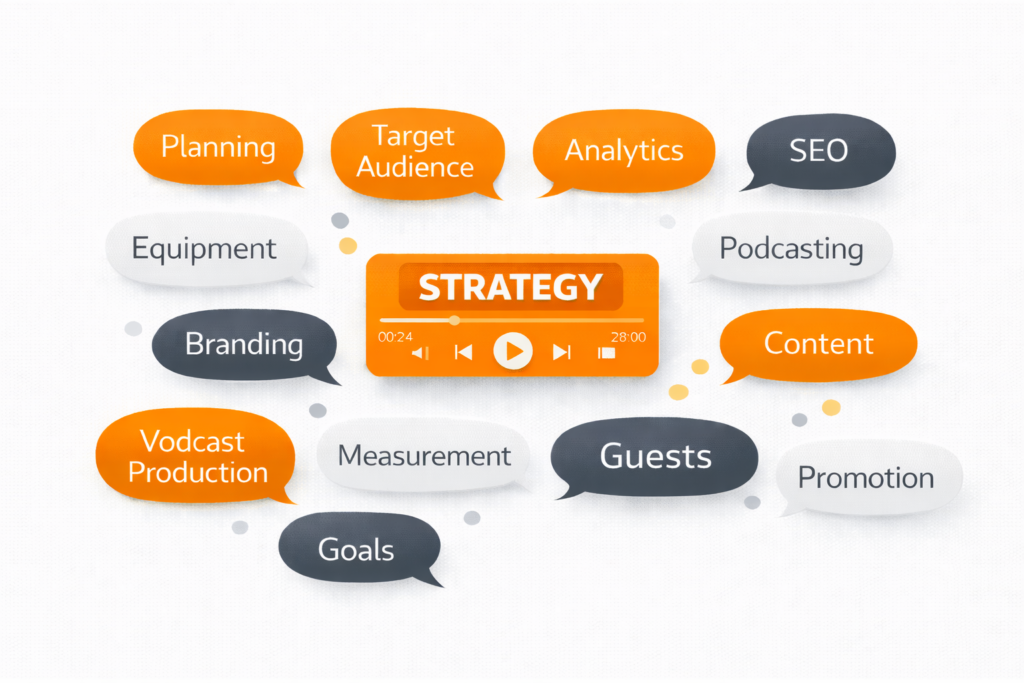
1. Pre-Production
Pre-production is where your show truly begins. This phase shapes the identity of your podcast and sets the stage for a smooth recording process. When done well, it saves time, reduces mistakes, and creates a stronger listening experience.
Content Planning
Rule number one: be interesting. You don’t want your podcast to sound like the all too familiar rambling phone call… that’s not going to stand out.
The best podcasts start with a clear creative foundation. You’ll define the concept, topics, guests and episode structure before any microphone switches on. This includes your core theme, recurring segments, and the opening and closing style. It also covers the episode flow—how you move from the intro, into the conversation, and toward a final takeaway.
At AsiaWorks, we help clients refine these frameworks, so every episode feels intentional, structured, and on-brand. A well-planned structure keeps the show consistent while still leaving room for spontaneity.
Vodcasts or Video Podcasts
This doesn’t just mean popping a single camera or smartphone in the room, or recording your Zoom/Teams call. If you have the budget or you’re willing to invest in professional support, shooting on multiple cameras with cinematic lighting, you can really enhance production value and viewership.
Simply put, vodcasts get better engagement, and there’s plenty of data out there showing that video podcasts can attract more viewers than audio-only shows. Definitely a boost for your podcast’s visibility.
Target Audience and Guest Booking
A successful podcast knows exactly who it is speaking to. Spend time defining your target listener. Consider what they care about, the tone they respond to, and the level of expertise they expect. This clarity informs your content decisions and ensures that every episode resonates.
Guest booking typically happens during this stage too. You’ll build a list of potential guests, confirm schedules, and prepare briefing notes to help them feel confident and ready. Clear preparation results in more natural, compelling conversations. And remember, they need to hold a listener’s attention.
Equipment and Technical Setup
The right equipment protects your audio quality from the start. Most setups include a professional microphone, an audio interface, quality headphones, and reliable recording software. A controlled environment—either a studio or a quiet room with acoustic treatment—makes a major difference.
AsiaWorks provides full studio setups and mobile recording kits for clients who want professional-grade sound in any location. With the right gear in place, the production process becomes smoother and more consistent.
2. Production
Production is where your planning becomes real. This stage focuses on capturing clean, natural audio and guiding the conversation, so it stays engaging.
Guest Preparation
A relaxed guest always delivers a better interview. Before recording, it helps to brief them with key talking points and simple microphone techniques. A short pre-interview can reduce anxiety and build rapport, which leads to stronger moments during the conversation. those interviews you hear where it seems ‘off the cuff’ are actually very well reheased.
Good preparation keeps the dialogue focused without feeling scripted.
Recording
Recording is the heart of the podcast production process. It involves monitoring sound levels, keeping microphone distance consistent, and maintaining a steady pace. Hosts and guests should avoid talking over one another so mistakes can be cleaned up later.
Many producers also capture a few seconds of “room tone.” This helps create smooth transitions during editing and keeps the sound consistent.
To ensure broadcast quality output, AsiaWorks uses broadcast-quality capture to ensure every voice track is crisp, warm, and free from distracting noise.
3. Podcast Post-Production
Podcast post-production shapes the listening experience. It’s where you polish the raw audio, refine pacing, and add the finishing touches that make the show sound professional.
Editing
Editing removes mistakes, tightens the dialogue, and structures the episode flow. This includes reducing filler words (um, ah, yeah, like, okay), closing long gaps, and improving clarity. The goal is to keep the episode engaging from start to finish.
Refining
Refinement adds polish and brand personality. Engineers adjust EQ to balance tone, apply compression for consistent volume, and remove background noise. They also add intro and outro music, transitions, and branded sound elements that reinforce your identity.
This stage is where your podcast starts to feel complete.
Exporting
Most podcasts export episodes in high-quality WAV or MP3 files. Many platforms recommend 44.1 kHz audio at 128 kbps, though higher-quality settings are common for long-form or narrative formats that feature extensive use of sound effects.
Publishing, Distribution & Promotion
Once your episode is ready, it needs a home. Popular hosting platforms include Spotify for Podcasters, Libsyn, Acast, and Buzzsprout. These services distribute your show across major apps like Spotify, Apple Podcasts, and Google Podcasts.
Promotion happens across multiple channels. Brands often repurpose episodes into Instagram Reels (when video is used), TikTok clips, LinkedIn posts, email newsletters, and audiograms. Blog recaps and highlight reels can also help extend the life of each episode.
Engagement data and analytics should never be overlooked and a strategy for ongoing support to market, measure and refine your podcast production and distribution should always be a key consideration.
AsiaWorks supports clients with multi-platform distribution strategies to help episodes reach the target audience (or a wide audience) and stay relevant longer.
How Much Does It Cost to Produce a Podcast?
Podcast production costs vary widely, but most budgets depend on three things: your podcast production workflow, how often you publish episodes, and the overall complexity of the show. Some brands only need light editing and simple hosting. Others require a full production team, multi-guest interviews, or vodcasting/video podcasting. Every layer adds time, expertise, and equipment which naturally increases the final cost.
AsiaWorks has worked with brands across Asia at every budget level. We help clients understand where their investment has the biggest impact, whether they want a simple conversation-based podcast or a polished, multi-platform series.
1. Common Cost Drivers
Before you estimate your podcast production budget, consider the factors that influence pricing:
- Number of episodes per month: more episodes = more production hours.
- Episode length: longer recordings require more editing and mixing time.
- Number of guests: accommodating guests adds complexity, coordination, and additional audio processing.
- Level of editing required: basic cleanup is cheaper than full narrative editing or sound design.
- Whether you’re producing an audio-only or video podcast: video increases equipment, crew, and post-production time. We’ve had clients who wanted video but discovered it doubled the cost.
- Recording location or studio rental: acoustics, convenience, and availability affect cost.
- Turnaround speed (we need it tomorrow!): urgent deadlines often require additional resources.
These variables help determine the size of your team, the tools needed, and the number of hours required to deliver a polished episode.
2. Additional Cost Drivers: Strategy, Development & Distribution
Beyond recording and editing, several strategic and long-tail elements can significantly influence overall podcast investment. In actual fact, these are the critical elements that ensure success in the ever crowded podcasting space.
Pre-production development & concepting
Building a solid foundation—show format, tone of voice, series structure, episode arcs, host preparation, and guest planning—adds time upfront but reduces cost and confusion later. Premium shows typically invest more here.
Research, scripting & story development
Producing business-grade or narrative-driven podcasts often requires editorial planning, interview research, writing intros/outros, and shaping talking points. More editorial control = higher production hours.
Branding, design & episode templates
Creating consistent branding (cover art, episode thumbnails, social tiles, motion graphics, audio stings) adds early setup costs but scales across the whole series.
Distribution strategy & platform setup
Uploading to hosting platforms, setting up metadata, managing RSS feeds, optimising titles and descriptions, and ensuring compliance across Spotify, Apple, Google etc. adds technical overhead, especially for corporate teams.
SEO-optimised titles, descriptions & show notes
Well-written metadata significantly improves discoverability. Researching keywords, competitors, and content clusters increases editorial time compared to simple descriptions.
Social media cutdowns & promotional assets
Many brands request short videos, audiograms, image tiles, or quote cards for LinkedIn campaigns. Each additional asset increases post-production hours.
Ongoing measurement & analytics
Tracking episode performance, listener behaviour, drop-off points, download growth, and social engagement requires time every month. High-touch clients also expect insight reports and recommendations for refining future episodes.
Audience development & continuous optimisation
Adjusting show format, improving scripts, evolving promotion strategies, and refining distribution based on data adds continuous strategic effort that can increase the overall cost of a podcast programme.
Typical Cost Breakdown
A full podcast production only budget usually includes three key stages: pre-production, production, and post-production.
Pre-Production
This stage sets the direction of the show. Your costs might include:
- Concept development
- Research and scripting
- Show format planning
- Guest outreach and scheduling
- Episode preparation and run-downs
If your podcast relies heavily on research, multiple guests, or custom scripts, pre-production will represent a larger portion of your budget.
Production
Production covers everything that happens during the recording session. Costs may include:
- Studio or on-site recording
- Audio engineer and equipment operator
- Microphones, headphones, and acoustic treatment
- Backup recording systems
- Video equipment (if producing a vodcast or video podcast)
- Travel, if recording outside a major city
AsiaWorks provides both in-studio setups and mobile recording kits to ensure professional audio quality in any environment. We have produced podcast in executive boardrooms and sound booths.
Post-Production
Post-production is where your episode becomes polished and audience-ready. This stage can vary significantly depending on your podcast’s style.
Typical tasks include:
- Editing mistakes, pauses, and filler words
- Removing background noise
- Tightening pacing
- Merging multiple audio tracks
- Adding intro/outro music
- Mixing and mastering for consistent volume
- Applying EQ and compression
- Exporting to distribution-friendly formats
- Metadata writing and SEO
- Uploading to your hosting platform
- Production of promos, trailers, thumbnails and episode artwork.
The more storytelling, sound design, or creative transitions your show needs, the more time-intensive post-production becomes.
Equipment Costs
If you’re producing a podcast in-house, equipment costs can be a mix of one-time purchases and ongoing expenses. Here is our suggested lists based on our experience:
One-time Equipment Purchases
- Professional microphones
- Headphones
- Audio interface
- Pop filters
- Mic stands and boom arms
- Acoustic panels
- Lighting (for video podcasting)
Ongoing Costs
- Hosting subscriptions (e.g., Libsyn, Spotify for Podcasters)
- Editing software (Audition, Descript, Hindenburg)
- Storage and backup solutions
- Music licensing fees
- Remote recording platforms (e.g., Riverside, SquadCast)
AsiaWorks helps clients scale intelligently by recommending equipment that fits their content goals and long-term production plans. We suggest hiring an agency to help you if you’ve never produced a podcast before.
Typical Cost Range Summary
Production Tier | What You Get | Typical Cost (USD) |
Starter / DIY | Record-from-home + basic cleanup | $150 – $600 / episode |
Freelancer Level | Remote producer + structured edit | $600 – $3,500 / episode |
Agency Level | Full-service editorial + studio recording + full post | $4,000 – $15,000 / episode |
Enterprise Level | Strategic development + multi-camera video podcast + full social rollout + ongoing analytics and strategy | $12,000 – $50,000+ for development + recording costs |
AsiaWorks offers scalable podcast production packages tailored to corporate teams, founders, and branded content needs across Asia. For more information, please get in touch with us.
Equipment & Tools to Streamline Podcast Production Workflow
Essential Recording Equipment
- Dynamic or Condenser microphones
- Audio interfaces
- Mixers
- Closed-back headphones
- Pop filters
- Mic stands
- Acoustic treatment panels
Recommended Software Tools
- Planning: Notion, Trello, Google Docs.
- Recording: Adobe Audition, Riverside, Rode Connect, Descript, Squacast, Zoom, Teams.
- Editing: Audacity, Descript, Adobe Audition
- Distribution: Spotify for Podcasters, Libsyn, Buzzsprout, Captivate, YouTube.
How to Find a Podcast Producer
Finding the right podcast producer can make or break the quality of your show. The best places to start are professional production agencies (like AsiaWorks), freelance marketplaces, LinkedIn searches, and industry communities where creators share a portfolio of their work. Each option has strengths, but a professional agency offers the most reliable podcast production workflow and long-term consistency.
Working with a podcast production agency gives you access to a clear process, high-quality equipment, and expert storytelling support. Agencies deliver polished audio, faster turnaround times, and stable production standards across every episode. They also bring access to studios, professional podcast production equipment, and tools you may not have in-house. Most importantly, they understand how to shape branded content in a way that feels authentic and engaging.
AsiaWorks brings 3 decades of regional media experience. We support brands across Singapore and Asia with professional podcast production that blends strong editorial thinking, technical excellence, and a smooth end-to-end workflow.
Additional Podcast Production Tips
1. Build a Scalable Workflow
A scalable workflow helps you stay consistent. Batch-recording episodes, planning formats in advance, and using templates for editing will streamline your entire podcast production process.
2. Strengthen Storytelling
Storytelling, and telling good stories, can create a clear narrative arc. Use the structure hook → context → insight → takeaway to keep listeners engaged and give each episode a meaningful flow.
3. Keep Audio Quality Consistent
Try to record in the same environment for every session. Use stable microphone settings and a controlled acoustic space so your sound remains smooth, balanced, and professional.
4. Improve Host Delivery
Hosts should bring energy, speak clearly, and guide conversations with confidence. Active listening and smooth transitions make the episode feel polished and natural. You don’t need to have great delivery, but you do need to be interesting to listen to.
5. Repurpose Your Content
Podcast episodes can fuel many forms of content. Turn them into social clips, articles, audiograms, Reels, or newsletter features to extend reach and improve ROI. AsiaWorks helps clients repurpose or re-edit their shows so each recording creates value across multiple platforms.
How AsiaWorks Can Help You with Your Podcast Production
AsiaWorks provides end-to-end professional podcast production services. We support planning, equipment setup, on-site or studio recording, expert editing, and multi-platform distribution. We work with corporate communication teams, founders, CEOs, nonprofits, and brand storytellers who want high-quality audio that reflects their identity.
AsiaWorks has produced content across Asia for more than 25 years. We bring the same high production standards to podcasting that we bring to corporate video and broadcast storytelling: helping brands publish shows that sound polished, credible, and memorable.
Podcast Production FAQs
1. What should a high-quality podcast include?
A great podcast includes clear audio, strong storytelling, thoughtful pacing, and consistent branding. It should also have clean editing, memorable segments, and a structure that keeps listeners engaged from start to finish.
2. How hard is it to produce a podcast?
Producing a podcast is simple at a basic level but becomes more complex when you aim for professional quality. Challenges include soundproofing, editing, mixing, sound effects, and managing guests. Working with a podcast producer or agency can ease this workload.
3. How do you produce a podcast remotely?
For Remote production, common platforms include Riverside, Descript, Squadcast, even Zoom and Teams. Some of these platforms are able to record each guest in high-quality audio locally, on their side, and then a producer can then sync and edit those files in post-production. This allows for enhanced recording quality compared to Zoom or Teams.
4. How long should a podcast episode be?
Most business or branded podcasts are 20–40 minutes. Educational formats often run longer. The key is maintaining value and avoiding unnecessary filler. In short, keep it interesting.
5. Can a podcast be both audio and video?
Yes. Video podcasts are now common on YouTube, LinkedIn, and TikTok. Many brands record both formats to increase reach. AsiaWorks frequently supports clients with dual-format production.