
Key Takeaways
- A strong video concept acts as the blueprint for your entire production.
- Clear goals, audience insights, and narrative structure lead to better results.
- Creative development tools, from storyboards to AI, can streamline your workflow.
- AsiaWorks helps businesses turn early ideas into strategic, production-ready concepts.
Table of Contents
In a world where the video content we consume is dominated by viral trends, social media platforms, creators and influencers, you’d be forgiven for believing that a smartphone is all you need. But the real story behind effective content starts somewhere very different.
The fact is that many of us overlook the importance of a fully conceived concept: the thing that shapes everything, from the purpose of your video, the story and visuals, to pacing and platform. Most importantly, a well designed concept ensures that your objectives can be measured and met.
Strong video concepts help businesses and brands cut through the noise, stay consistent across campaigns, and speak directly to the audience who matter to them.
Whether you’re a marketer, content creator, or business owner, learning how to develop a clear concept for video will help you produce content that performs better and feels more intentional. At AsiaWorks, we’ve spent 30 years helping our clients across Asia Pacific turn creative video concepts into polished, high-impact stories that bring results. This guide shows you how to develop your own ideas with structure and confidence.
What Is a Video Concept?
A video concept is the core idea that shapes your entire project. It’s the creative foundation that defines what the video is about, why it matters, and how the story will be told. Think of it as the blueprint that guides every creative and technical decision. A strong concept captures the message, tone, visual style, and emotional hook in a simple, clear explanation. Whether you’re crafting creative video concepts, or building a branded content series, the concept outlines the essence before any cameras roll.
In practical terms, the video concept acts as the bridge between your business goals and your audience’s expectations. It distills complex information into a single, compelling direction that everyone on the production team can follow.
AsiaWorks helps clients refine their video concept ideas into structured, strategic approaches that resonate across platforms and deliver measurable impact. A well-defined concept ensures your content is intentional, memorable, and aligned with your brand.
Why Is Video Concept Development Important in Production?
Video concept development is one of the most important stages in the production process because it sets the creative and strategic direction for everything that follows.
Without a clear concept, teams often waste time, resources, and budget producing content that feels scattered or disconnected from business objectives. A strong concept gives structure to your story, clarifies the tone and mood, and ensures the final video aligns with your marketing goals.
This development stage also guides the production crew by providing a unified vision of what the video needs to achieve. It informs the script, visuals, pacing, and platform-specific requirements, which helps teams avoid miscommunication or costly revisions later. When everyone—from writers to camera operators to editors—works from the same conceptual framework, the production becomes more efficient, and the result is more cohesive.
From a business perspective, solid concept development keeps the project aligned with measurable outcomes. It ensures the video supports the right call-to-action, speaks to the correct audience, and reflects brand identity across every scene.
By refining the structure of a video before production begins, we help brands produce content that performs well, communicates clearly, and stands out in a crowded digital landscape.
How to Develop a Video Concept
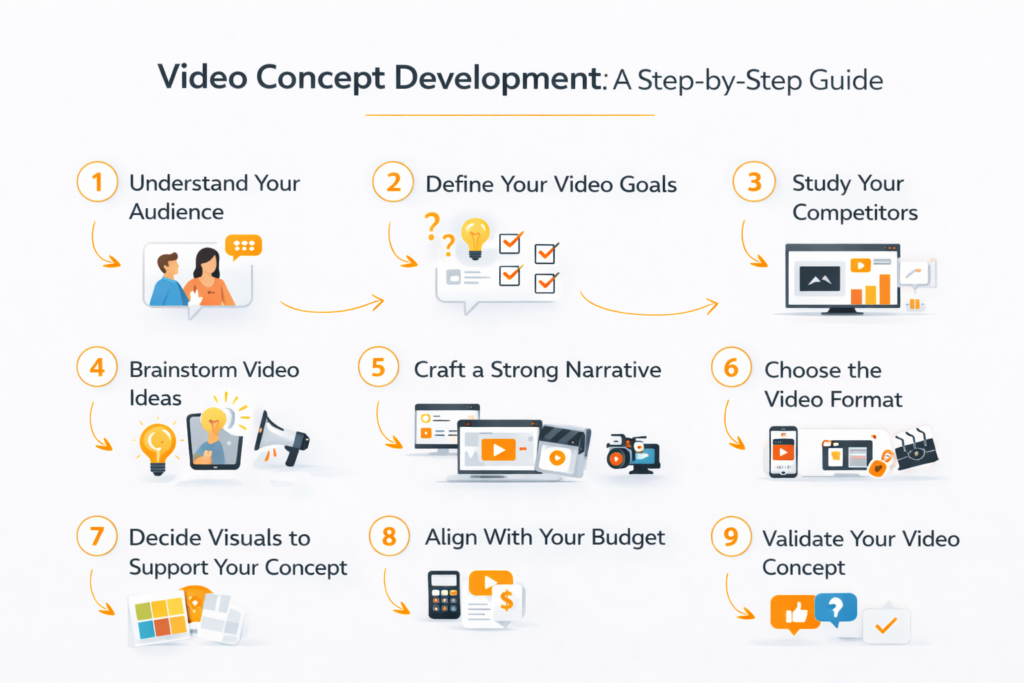
1. Understand Your Audience
We have found that the best creative video concepts start with audience insight. Who are you trying to reach? Build basic personas that describe demographics, motivations, pain points, and preferred content formats. For example, younger audiences may prefer short-form social videos, while professionals on LinkedIn may value longer, insight-driven content.
When you understand your audience, every creative decision becomes easier, and far more impactful.
2. Define Your Video Goals
Your video goals shape the entire structure of a video. Are you trying to build awareness? Drive conversions? Improve engagement? Teach something new? Each objective requires a different tone, pacing, and visual approach. A conversion-focused concept looks different from an educational one. Defining your goals early ensures your video concept stays aligned with business outcomes.
3. Study Your Competitors
Have a look at how your competitors’ express ideas through their online videos. Look at their formats, storytelling style, and success metrics (views, comments, completion rates are easy to see). Competitor research helps you spot gaps, avoid repeating common ideas, and position your video content uniquely.
4. Brainstorm Video Ideas
Brainstorming is where creative video concept ideas begin to take shape. Use techniques such as:
- “What if?” scenario exploration
- inspiration boards
- reverse storytelling (starting with the ending, the big impact!)
Encourage a plethora of ideas first—quality comes later.
5. Craft a Strong Narrative
Every compelling video concept has a clear storytelling framework. You can build narratives using:
- the hero’s journey (how she/he/we helped)
- the problem–solution approach (think all those weight loss ads where we go from fat to thin)
- the three-act structure (setup → conflict → resolution)
A strong narrative gives your concept emotional depth and keeps your audience invested from beginning to end
6. Choose the Video Format
Format selection is a major part of concept development. Decide whether your idea works best as:
- a short-form social clip
- a long-form YouTube video
- an explainer
- a tutorial
- an advertisement
- a testimonial
Consider the platform’s strengths. Vertical videos excel on TikTok and Instagram, while long-form content thrives on YouTube. A great editor who edit formats is critical.
7. Decide Visuals to Support Your Concept
Visual decisions turn ideas into something viewers can picture. Think about:
- tone and mood
- colour palette
- camera movement
- graphics or titles
- transitions
- lighting style
These choices must support the emotional message. AsiaWorks helps clients translate video concept ideas into concrete visual directions that elevate storytelling.
8. Align With Your Budget
Your video production concept must match your budget. High-end creative video concept development may include multiple locations, actors, animation, or specialised equipment.
Smaller budgets may favour interview-led stories or simple product demos. Budget alignment ensures your idea is achievable and prevents scope creep later.
9. Validate Your Video Concept
Validation reduces risk. Share your concept with a small group of viewers—customers, colleagues, or stakeholders. If feedback reveals gaps or confusion, refine and strengthen your concept before production.
Tools and Techniques for Video Concept Development
Storyboarding and Scriptwriting Tools
Platforms like Canva, Milanote, and Celtx help transform ideas into visual plans. Storyboards outline the sequence of shots, while scriptwriting templates make it easier to structure dialogue and narration. These tools ensure your video concept ideas translate smoothly into production.
Utilising AI Tools
AI tools can support the early stages of concept creation. They assist with brainstorming, research, title ideas, and visual inspiration. Used strategically, AI accelerates creative development without replacing your unique perspective.
Collaboration Platforms
Platforms like Miro and Figma enable smooth co-creation. Teams can review storyboards, comment on scripts, and refine ideas in real time. These tools streamline the structure of a video and keep the creative process organised.
Video Concept Examples
Strong video starts with a strong idea. Here are a few recent concepts we’ve developed, each built to simplify complex topics, tell clear stories, and deliver measurable results.
Example: Impact Story Video
The brief from the UK Government and the British Chamber of Commerce Singapore, was to bring real clarity to a complex topic: how digitalising manual tasks, paperwork, and bureaucracy unlocks smoother trade. We developed a clear, well-structured concept that combined leadership interviews with dynamic graphics to visualise key data points and policy impacts. Featuring the British High Commissioner, the HM Trade Commissioner for APAC, and the Chamber’s Executive Director, the video delivered an authoritative narrative that performed strongly across channels like LinkedIn.
Example: Social Media Video Series
The brief was to create a clear, strategic format that brought Mastercard’s APAC stories to life on LinkedIn. We created In The Loop, to give Mastercard a sharper way to share APAC stories on LinkedIn. The concept is simple: fast, news bulletin-style episodes led by the APAC Comms team, mixing thought leadership with clear, uncluttered storytelling. And it worked. Independent brand-lift studies showed a 20% jump in favourability among people who watched the content—well above industry benchmarks.
Common Mistakes to Avoid in Video Concept Development
We have seen many clients overcomplicate their storylines or ignore audience needs entirely. Others forget to tailor concepts for specific platforms, leading to weak engagement.
Avoid concepts that lack emotional clarity or rely too heavily on trends without strategic grounding. Poor planning leads to misaligned production and inconsistent messaging.
Measuring the Success of Your Video Concept
Success can be measured through:
- completion rates
- audience retention
- engagement metrics
- conversions
- qualitative feedback
This links closely to the broader world of video metrics, and tracking these helps you refine future concepts with data—not guesswork.
Final Thoughts
Great videos start long before the camera rolls. They begin with thoughtful, strategic video concept development. By understanding your audience, defining your goals, crafting strong narratives, and validating your ideas, you can create video content that stands out and achieves real results.
AsiaWorks helps brands across Asia turn creative video concepts into high-quality productions. With decades of experience and teams across the region, we support clients at every step, from concept to screen (theater, television or mobile). If you want help developing powerful concepts for your next campaign, AsiaWorks is ready to work with you.
Video Concept FAQs
1. What makes a video concept unique?
A unique video concept offers a fresh perspective, clear emotional intent, and a strong narrative hook. It communicates your message in a way that feels original yet relevant to your audience. Unique concepts often combine insight, creativity, and a refined storytelling structure.
2. What are the future trends of video concept development?
Future trends include AI-assisted ideation, hyper-personalised narratives, modular video concepts for multiple platforms, and interactive storytelling. As online video concepts evolve, brands will rely more on data-driven insights to shape creative direction.
3. What should a video concept include?
A complete concept includes:
- a core idea and message
- target audience
- tone and style
- narrative approach
- visual direction
- platform placement
- call to action
These elements create clarity for the entire production team.
4. What’s the difference between a video concept and a script?
A video concept outlines the essence of the idea, while a script provides the exact words, pacing, and scene details. The concept guides the creative approach; the script translates it into dialogue and structure.
5. Can I reuse a video concept for multiple platforms?
Absolutely. Most strong concepts can be adapted for various platforms. However, each platform requires different lengths, formats, and storytelling techniques. A single concept may produce multiple edits, ensuring your message stays consistent while still performing well on each channel.