

Key Takeaways
- A script for video production is both a storytelling tool and a production blueprint.
- Strong scripts reduce filming time and improve clarity.
- Structure matters: hook, problem, solution, and action.
- Different platforms require different scripting approaches.
- AsiaWorks integrates scripting into every stage of production for better results.
Table of Contents
Every great video starts long before the camera rolls. It starts with a script and a lot of planning.
Whether you are creating a brand film, a social clip, or a corporate message, knowing how to write a script for a video is what separates content that feels polished from content that feels improvised or amateurish.
In today’s always-changing digital content landscape, audiences expect high-production clarity, pace, and purpose (often that looks natural and unscripted). Therefore, script writing for video production is no longer optional, it is essential.
In this guide, we break down how to write a script for a video, from strategy to structure. You will learn practical frameworks, platform-specific tips, and production-ready templates. In addition, we will show how AsiaWorks approaches scripting as part of a client’s professional video workflow.
What is a Video Script? (And Why You Can’t Skip It)
A video script is more than dialogue. It is a structured document that outlines what the viewer sees and hears, including visuals, timing, and tone. It’s the narration of a story.
In other words, it is the bridge between an idea and a finished video.
Without a script, production becomes inefficient. Teams waste time on set, messages become unclear, and edits take longer. However, with a strong script for video production, everything aligns, from storytelling to execution.
Moreover, scripting ensures consistency. Whether you are producing a script for marketing video, a corporate message, or script writing for educational videos, the script keeps your brand voice clear and focused.
Finally, a script helps you time the video. A good script will help you know when to stop. If you’re producing a video for exactly 30 seconds, the script will give you the timing for your visuals and messaging.
Pre-Scripting: Defining Your Video Strategy Before Writing
Before writing a single line, you need a plan.
First, define your audience. Who are you speaking to? What do they care about? What do you want to tell them? Without this clarity, even the best-written script will miss the mark.
Next, define your goal. Are you building awareness, driving conversions, or educating your audience? Each objective requires a different approach to creating a script for a video.
Then, consider your speaker. Is it a CEO, a customer, or a voiceover or a combination? The tone and delivery will shape how the script is written.
Finally, determine the format. A format for video script varies depending on whether the content is for YouTube, LinkedIn, or short-form platforms.
At AsiaWorks, this pre-scripting phase is critical. It ensures that every script aligns with both the brand’s creative intent and business outcomes.

How to Write Your Video Script in 8 Simple Steps
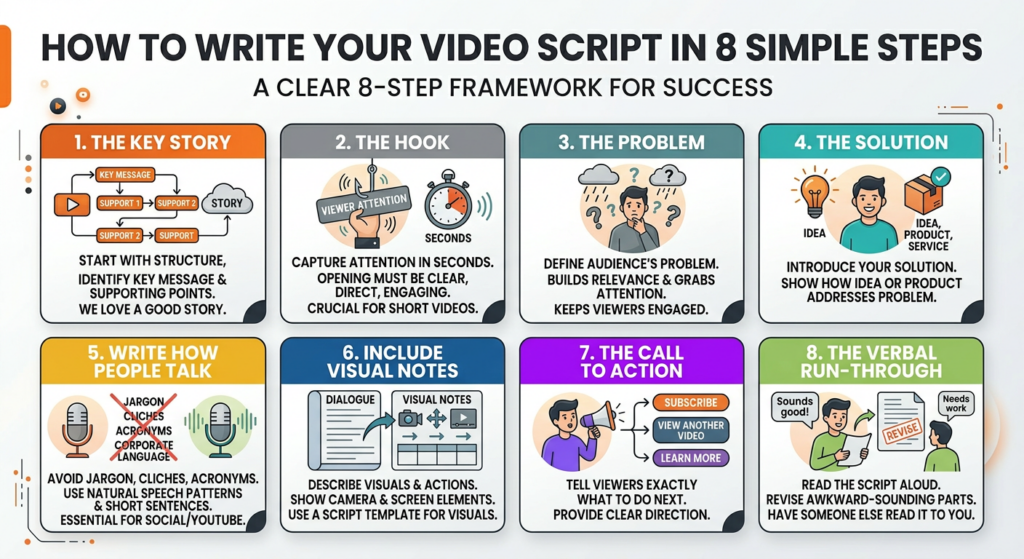
1. Outline The Key Story
Start with structure, not sentences. Identify the key message and supporting points before writing dialogue. Remember, we (human beings) love a good story.
2. The Hook
You have seconds to capture attention. Therefore, your opening must be clear, direct, and engaging. This is especially important when writing a script for a short video.
3. The Problem
Next, define the problem your audience faces. This builds relevance, grabs attention and keeps viewers engaged.
4. The Solution
Now, introduce your solution. Show how your product, service, or idea addresses the problem.
5. Write How People Talk
Avoid corporate language, jargon, cliches, and acronyms. Instead, use natural speech patterns. Short sentences improve clarity and engagement.
This is essential for how to write a script for a YouTube video or social content.
6. Include Visual Notes
A script must describe visuals. What does the camera show? What appears on screen?
This is where a template for video script becomes useful.
7. The Call to Action
Every video needs direction. Tell viewers exactly what to do next, even if it’s to view another video or learn more about the company.
8. The Verbal Run-through
Finally, read the script aloud. If it sounds awkward, it needs revision. Or have someone read it to you.
The A.A.A.A. Formula for Better Video Scripts
To simplify the process, many professionals use the A.A.A.A. formula:
- Attention – Start strong. Capture interest immediately.
- Advantage – Explain why it matters.
- Action – Tell viewers what to do.
- Adherence – Leave a lasting impression.
This structure works across formats, from script for marketing video to corporate storytelling.
How Should a Video Script be Formatted?
Most professional scripts use a two-column format.
Dialogue/Sound (Audio) | Visual (Video) |
Dialogue, voiceover, music, sound effects | Scene description, camera angles, text overlays |
This format ensures clarity for the client, production teams and editors.
It is especially useful for script template for video production workflows, where multiple teams collaborate. It allows for easy inputs from both the client and production teams.
Video Script Writing Tips for Different Platforms (YouTube, TikTok, LinkedIn)
Each platform requires a different approach.
1. YouTube
Scripts can be longer. However, structure is key. Strong intros and clear transitions improve retention. This is essential when learning how to write a script for a YouTube video.
2. TikTok and Reels
Keep it fast. Visuals change frequently. Hooks must appear immediately. Therefore, writing a script for a short video requires precision. Remember to add in a lot of graphics and subtitles.
3. LinkedIn
Focus on value. Professional audiences expect clarity and insight. Scripts should feel informative yet concise. The best land their ‘hook’ in 15 seconds or less.
Production-Ready Checklist for Video Script
Before filming, your script must be production ready. At AsiaWorks, teams review scripts using a structured checklist similar to the following:
- Is the timing accurate when read aloud?
- Has the script passed marketing leads, legal or compliance review?
- Are visual cues clearly defined?
- Are locations specified for each scene?
- Are all speakers identified?
- Are sound, music, and voiceover notes included?
- Are props and wardrobe mentioned?
This ensures smooth execution during filming.

Video Script Templates and Examples
Script Template for Product Explainer Videos
Audio (Dialogue/Sound) | Video (Visual) |
“Still struggling with [Problem]? You’re not alone.” | Person at desk looking frustrated |
“Meet [Product]. It simplifies your workflow instantly.” | Product interface demonstration |
“Start your free trial today.” | Logo and CTA screen |
Script Template for Educational Videos
Audio (Dialogue/Sound) | Video (Visual) |
“Today, we’ll explain how [Topic] works.” | Presenter on screen with graphics |
“Here’s the key concept you need to know.” | Animated diagrams |
“Try applying this today.” | Summary text overlay |
Script Template for Corporate Videos
Audio (Dialogue/Sound) | Video (Visual) |
“At our company, we believe in…” | Office environment, team shots |
“Our mission is to…” | Leadership interview |
“Join us on this journey.” | Brand logo and tagline |
Script Template for Marketing Videos
Audio (Dialogue/Sound) | Video (Visual) |
“Looking for a better solution?” | Quick montage |
“Here’s what makes us different.” | Product highlights |
“Get started today.” | CTA and branding |
How AsiaWorks Integrates Scripting into Video Production
At AsiaWorks, scripting is not a standalone step. It is part of a larger creative process that can involve hours of planning.
The team collaborates with clients from the initial brief through to final production. Writers, directors, and producers work together to refine the script so it is both creative and practical.
This approach ensures that all script writing for video production is aligned with production realities.
As a result, filming runs smoothly, and editing becomes more efficient. And the client has a clear set of expectations and deliverables.
In addition, AsiaWorks helps brands adapt scripts across formats. A single script can evolve into multiple outputs, including social clips, corporate films, and campaign assets.
Final Thoughts
Learning how to write a script for a video is one of the most valuable skills in modern content creation. And no, AI can’t figure out what YOU want to say to your audience.
A strong script improves clarity, saves production time, and ensures your message resonates with your audience. Moreover, it creates a foundation for high-quality storytelling.
Whether you are developing a script for video production, a corporate message, or a script for marketing video, the principles remain the same: clarity, structure, and purpose.
For brands looking to level up their content, working with a professional partner can make a significant difference. AsiaWorks combines strategic thinking with production expertise to deliver scripts that are not only well-written but also production ready.
Video Script FAQs
1. How long is a script for a one-minute video?
Typically, a one-minute video script contains around 120–150 words. However, pacing and visuals can affect this length. Therefore, always read the script aloud to ensure it fits naturally.
2. What are some common types of video scripts?
Common formats include explainer videos, educational videos, corporate videos, and marketing videos. Each format uses a slightly different structure, but all follow the same core storytelling principles.
3. What is the difference between A-Roll and B-Roll in a video script?
A-Roll refers to the main footage, such as interviews or direct-to-camera shots. B-Roll includes supporting visuals, such as cutaways, location or environmental shots. Both should be clearly indicated in the script.
4. What are common video script mistakes?
Common mistakes include writing overly complex dialogue or using acronyms, skipping visual notes, ignoring timing, and lacking a clear call to action. Additionally, failing to align the script with the target audience’s attention or expectations can reduce effectiveness.