

Key Takeaways
- Video pre-production is the planning stage before filming begins.
- Strong preparation reduces delays, budget overruns, and production mistakes.
- Every project requires a structured pre-production planning for video workflow.
- Different video formats require different planning approaches.
- AsiaWorks manages logistics, scheduling, permits, and production coordination for brands and organisations across Asia.
Table of Contents
Creating a great video starts way before the camera starts rolling. The crucial work – pre-production – begins well before filming starts.
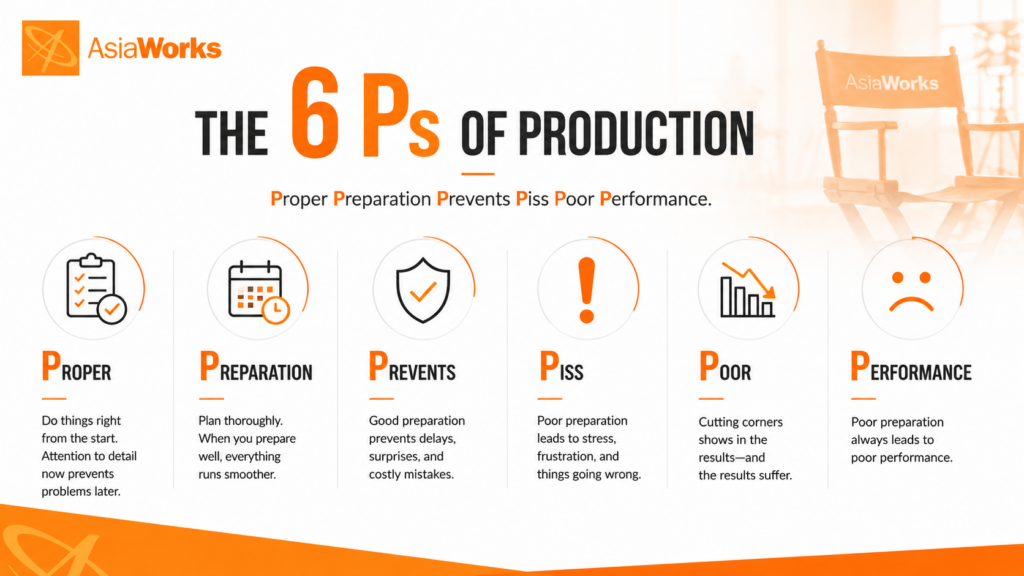
At AsiaWorks, we adhere to a simple mantra which we call the “six P’s of production“: Proper Preparation Prevents Piss Poor Production. While this philosophy is central to our entire process, it is nowhere more critical than during the pre-production phase.
Strong preparation is what separates a smooth production from a stressful one. Without a clear process, shoot days become chaotic, schedules fall behind, and budgets increase unexpectedly. That is why video pre-production has become one of the most important stages in modern content creation, separating the pros from the amateur teams.
Whether a company is producing a corporate brand film, an explainer video, a social campaign, or a documentary, preparation directly affects the result. Effective pre-production video planning allows teams to align on creative direction, logistics, scheduling, and technical requirements before filming begins.
Today, audiences expect polished storytelling and professional production quality across every platform, including mobile phone produced user-generated content or UGC. Consequently, brands cannot afford to approach filming casually. Every successful video production requires planning, coordination, and structure.
In this guide, we break down the complete video pre-production process, including practical planning steps, scheduling workflows, and production-ready checklists. We also explore how AsiaWorks approaches pre-production for video content projects.
What is Video Pre-Production and Why Does It Matter?
What is video pre-production?
Simply put, it is the planning phase that happens before cameras and crew arrive on location. This stage includes creative development and scripting, scheduling, budgeting, logistics, casting, and technical preparation.
A clear video pre-production definition would be: The process of organizing every creative and logistical detail before filming begins.
Without this stage, productions become reactive instead of strategic. Teams waste time solving avoidable problems during filming. Consequently, costs increase while creative quality often suffers.
Good pre-production in video production creates structure for both client and crew. It ensures that everyone understands the creative vision, timeline, and technical requirements before shoot day.
It also protects the budget. Careful planning reduces unnecessary overtime, additional shoot days, and rushed post-production fixes.
At AsiaWorks, pre-production is treated as the foundation of every successful project. Teams spend significant time aligning shooting, sound and lighting needs, logistics and storytelling before production begins. This allows crews to focus on execution once cameras start rolling.
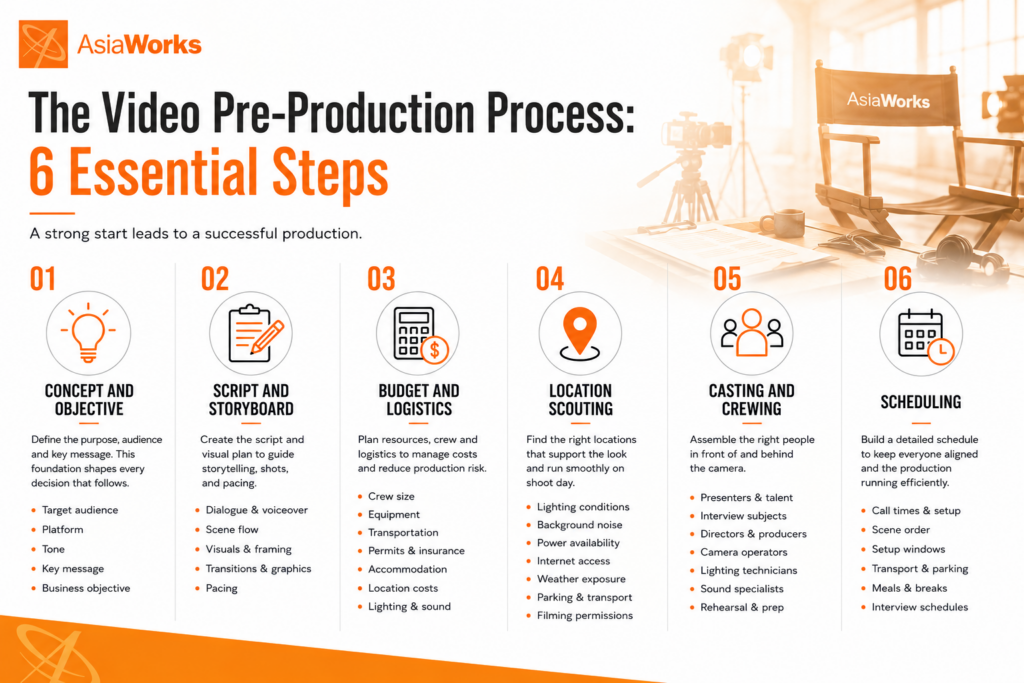
The Video Pre-Production Process: 6 Essential Steps
1) Concept and Objective
Every production begins with a simple question: What is the purpose of the video? Are you solving a problem, explaining a new product, or telling a brand story?
Some productions focus on brand awareness. Others support recruitment, internal communication, product launches, or education. Therefore, defining the objective early shapes every creative concept and logistical decision that follows.
During this stage, teams identify:
- the target audience
- the platform where the video will appear
- the desired tone
- the key message
- the business objective
This strategic foundation is one of the most important parts of the video pre-production process.
2) Script and Storyboard
Once the concept is approved, the next step is scripting.
The script outlines dialogue, voiceover direction, interview questions, and scene flow. Meanwhile, the storyboard provides a visual representation of what the audience will see on screen.
Storyboards are especially useful for explaining camera movement, framing, transitions, graphics, and pacing.
Strong scripting is one of the most important video content pre-production tips because it reduces confusion during filming. Crews understand exactly what footage is required before arriving on set.
At AsiaWorks, scripting, talking points and storyboarding often involve collaboration between producers, directors, writers, and clients. This ensures the final script remains both creative and practical.
3) Budget and Logistics
Production budgets influence almost every creative decision.
During this stage, teams determine:
- crew size
- filming equipment
- transportation
- permits
- accommodation
- location costs
- lighting and sound requirements
A well-structured budget helps production teams prioritize spending while avoiding unnecessary costs later in the process. And it gives the client a transparent view on how much different aspects of the production will cost.
For example, a one-day corporate interview shoot requires very different logistics compared to a regional documentary filmed across multiple countries.
Careful logistical planning also reduces production risk. Teams can prepare backup plans for weather, travel delays, or technical issues before filming begins.
4) Location Scouting
The filming environment affects both creative quality and operational efficiency.
Location scouting involves finding spaces that support the visual style of the production while remaining practical for filming.
Production teams evaluate:
- lighting conditions (mixed incandescent lighting and natural light)
- background noise (think air conditioning hum or traffic)
- power availability (can the power at the location handle studio lights)
- internet access (are large files being sent to the client)
- weather exposure (a rainy day looks very different from sunshine)
- parking and transportation (where do we park the equipment truck)
- filming permissions (is filming permitted in the building or outdoors)
Sometimes a location may look visually impressive but create logistical problems during production. Therefore, scouting helps identify risks before shoot day.
AsiaWorks frequently scouts locations across Asia for both regional and international productions. This includes corporate offices, factories, hotels, outdoor environments, and studio spaces. The last thing we want are surprises on production days.

5) Casting and Crewing
The people involved in production shape the final video as much as the script itself.
Casting includes presenters, actors, interview subjects, or voiceover talent. Meanwhile, crewing involves directors, producers, camera operators, lighting technicians, and sound specialists.
Strong collaboration between creative and technical teams is essential during pre-production in video production.
Preparation also helps non-professional speakers feel more comfortable on camera. Many corporate productions involve executives who may be nervous in front of the camera. Therefore, rehearsal and preparation become important parts of the process.
6) Scheduling
Finally, every production requires a detailed schedule.
Production schedules outline:
- call times and initial production setup
- scene order
- setup windows for camera and lighting
- transportation timing and parking
- meal breaks and budget for meals
- interview schedules
A clear schedule prevents confusion and keeps production days efficient.
AsiaWorks regularly creates detailed call sheets for productions involving multiple teams and stakeholders. These schedules help synchronize filming with business operations while minimizing disruption for clients.
Video Pre-Production Planning for Different Video Types
Different productions require different approaches to pre-production planning for video.
Corporate Videos
Corporate shoots often involve executives, approvals, and office environments. Therefore, timing and coordination become especially important. An executive’s time is often at a premium and limited, so it’s important to not waste their time.
As a result, crews must plan filming schedules carefully to avoid delays. Teams also need to prepare interview questions, talking points, and room setups (sometimes make-up and hair) before the speaker arrives.
Brand and Marketing Videos
Brand video campaigns focus heavily on visual identity.
During pre-production, teams often define:
- wardrobe direction
- lighting mood
- colour palettes
- product styling
- camera movement and pacing
These details help ensure the final production aligns with the brand’s larger marketing strategy.
Explainer Videos
Explainer videos rely heavily on scripts and visual planning.
Animators, designers, and editors require detailed instructions before production begins. Consequently, storyboards become especially important for explaining graphics, transitions, and on-screen text.
Educational Videos
Educational video content prioritizes clarity and structure.
Graphics, statistics, demonstrations, and examples should all be verified before filming begins. This reduces the risk of revisions later in production.
Scripted Films
Scripted productions require extensive planning.
Shot lists, rehearsals, prop coordination, and blocking all become major parts of the video pre-production checklist. Even small scheduling mistakes can affect an entire filming day.
Documentaries
Documentaries require more flexibility and storytelling.
Although producers may conduct pre-interviews beforehand, real-world events often shape the story during filming. Therefore, documentary crews must balance structure with adaptability. Be ready to tell the story as it appears.
How Pre-Production is Handled at AsiaWorks
At AsiaWorks, pre-production is treated as a professional discipline rather than a simple administrative phase.
The agency manages many of the operational details clients rarely see, including:
- Permits and Insurance: We research, apply for, and secure all necessary filming permits for every location used in the production. Clients never face legal delays or unexpected access restrictions on shoot day because we resolve these issues weeks in advance.
- Call Sheet Production: We create detailed, professional call sheets that coordinate every member of our crew and every point of contact on the client side. Every person — from the camera operator to the Marketing Manager on set — knows exactly where to be, at what time, and what to expect.
- Client Workflow Synchronisation: We map our pre-production timeline directly against the client’s internal approval processes, executive availability, and business calendar. Our goal is to ensure that the production schedule never creates friction for the client’s day-to-day operations.
- Technical Assessment: We visit every location in advance to assess lighting, power supply, audio environment, and access logistics. Our technical team identifies and resolves potential problems before they can affect the shoot.
- Talent and Crew Briefing: All on-camera talent and crew members receive comprehensive briefings before shoot day. For client spokespeople appearing on camera, we provide structured messaging guidance to reduce retakes and minimise time on set.
These details may seem small individually. However, together they form the operational backbone of a successful production. Without each step, production may be impossible.
AsiaWorks also works closely with clients to synchronize filming schedules with business operations and executive’s schedules. This minimizes disruption while helping productions remain efficient and on schedule.
For regional or local productions (such as in Bangkok and Jakarta), the agency often coordinates crews, transportation, and filming logistics across multiple countries. Consequently, strong planning becomes essential for maintaining consistency and quality.
Video Pre-Production Checklist: Things to Verify Before Shoot Day
A strong checklist for video pre-production helps avoid preventable production issues.
Before filming begins, our check list includes:
- Are all filming permits approved?
- Has equipment been tested?
- Are backup batteries and media prepared?
- Have all crew members received the final call sheet?
- Are wardrobe and props prepared?
- Is there a weather contingency plan?
- Are interview questions finalized?
- Are the interviewees aware of their scripting?
- Have legal or compliance reviews been completed?
Final Thoughts
The best productions rarely happen by accident. They are built through planning, communication, and preparation.
Strong video pre-production helps brands stay on schedule, reduce unnecessary production costs, and maintain creative quality throughout filming.
Whether producing a corporate interview, documentary, or marketing campaign, investing time into pre-production almost always improves the result. The general rule: the more pre-production, the less time in post-production.
At AsiaWorks, pre-production forms the foundation of professional video storytelling. From scripting and logistics to permits and scheduling, the agency helps brands execute productions smoothly across Asia.
Video Pre-Production FAQs
1) How long does video pre-production take?
The timeline depends on the complexity of the project. A simple interview shoot may require only several days of preparation, while larger campaigns may require weeks or even months of planning.
2) Can we skip pre-production if we have a simple video?
Even simple productions benefit from planning. Without preparation, teams often encounter avoidable delays and technical problems that waste time and money. And you risk an unhappy client when you waste their time and budget.
3) What is the most common mistake made during the pre-production phase?
One of the most common mistakes is underestimating logistics and the related costs. Productions often focus heavily on creative ideas while overlooking schedules, permits, or technical preparation.